The keepers' station
On a rock: three keepers aboard, one ashore, in rotation. At a shore station: families in the dwellings beside the tower. Duties are fixed by the clock. Light the lamp at sunset. Wind the clockwork through the night. Trim wicks. Polish glass and brass. Log weather and passing ships. Start the fog signal engines when visibility drops. Paint everything, constantly. Relief is by boat at first; landing at Skerryvore or Fastnet needs a flat sea and a steady hand on the derrick. Later, helicopters. Helidecks are built over the lanterns of sea towers, Eddystone among them, or on the rock beside.
Steps to no one home
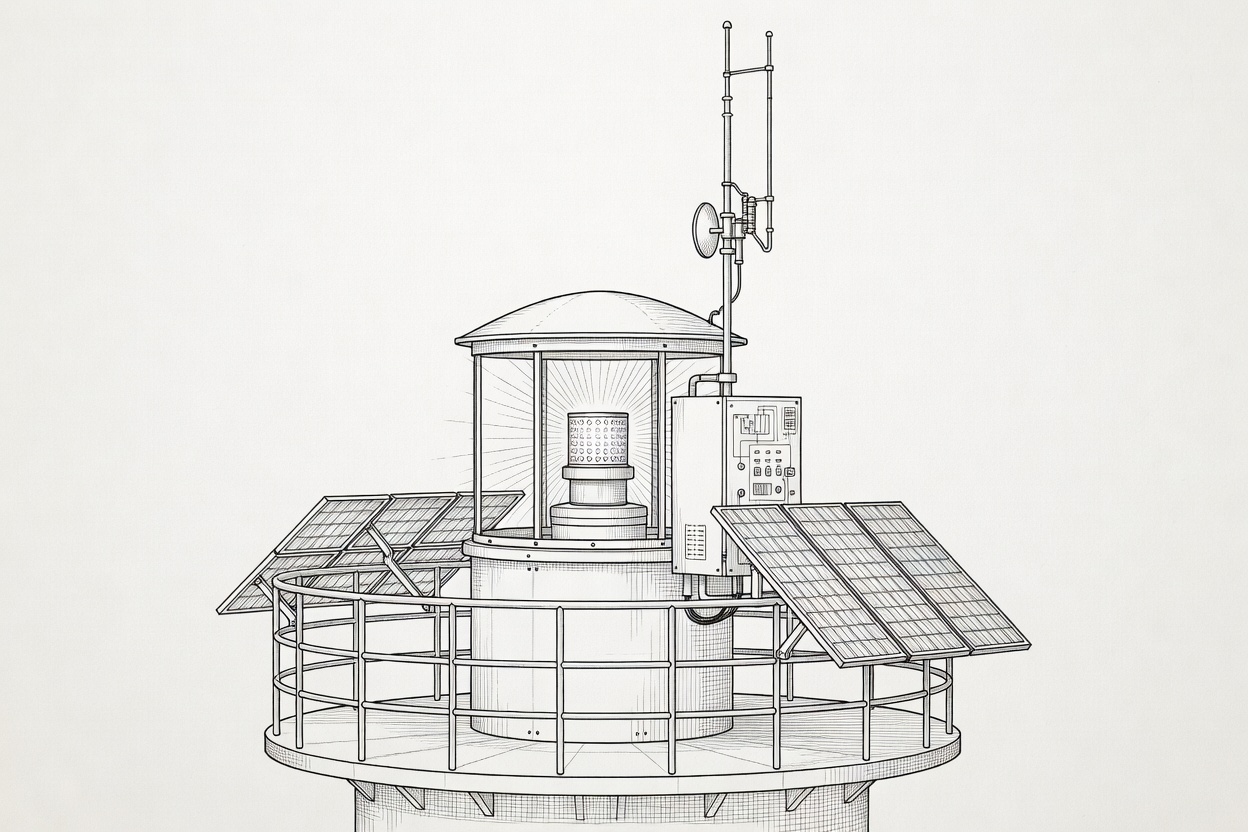
Electrification first: generators in the base, then mains where a cable can reach. The automatic lamp changer: a carousel that turns a fresh bulb into the focus when a filament fails, so a lamp failure is no longer an emergency. The fog detector: a sensor that measures scatter and starts the signal without a human judgement. Telemetry: status reported to a control room by landline, then radio, then satellite. Standby power that starts itself. Solar arrays with batteries at remote sites. LED sources cut power demand far enough that solar works even through a Hebridean winter. Each step removes one task. When no daily task remains, the station is declared automatic and the last keeper leaves.
Order of withdrawal
Rock stations go early, because they cost most to staff and relieve. Shore stations follow. The last Trinity House keepers leave North Foreland in Kent. The Northern Lighthouse Board's last keepers leave Fair Isle South. The Commissioners of Irish Lights' last keepers leave the Baily at Howth. Skerryvore has its own path: an internal fire guts the tower, it stands dark for years, is relit, and is automated later still. Bell Rock, Eddystone, Fastnet and South Stack are all automated and all monitored from ashore. The keepers' dwellings at South Stack become a visitor site; the signal tower at Arbroath that once talked to Bell Rock becomes a museum; the shore station at Hynish that served Skerryvore does the same.
Who watches now
| Authority | Area | Base | Stations on this site |
|---|---|---|---|
| Trinity House | England, Wales, Channel Islands, Gibraltar | London; operations and monitoring at Harwich | Eddystone, South Stack |
| Northern Lighthouse Board | Scotland, Isle of Man | Edinburgh | Bell Rock, Skerryvore |
| Commissioners of Irish Lights | Whole island of Ireland | Dún Laoghaire | Fastnet |
All three are funded through the General Lighthouse Fund, filled by light dues levied on ships calling at ports in the United Kingdom and Ireland. Each runs tenders for buoy work and station maintenance: Trinity House vessels carry the prefix THV, with Galatea in the fleet; the Northern Lighthouse Board's carry NLV, with Pharos; Irish Lights' Granuaile carries the prefix ILV. Engineers and technicians visit stations on a maintenance cycle rather than living in them.
Trade-offs
Reliability against response. A sensor reports a failed lamp in seconds; a technician still has to reach a rock in a gale. Cost against presence. Keepers' wages and reliefs against helicopters and contractors. Heritage against efficiency. Optics are removed, lantern rooms emptied, some preserved in museums, some sold. Fog signals against electronics. Many signals are discontinued as radar and satellite positioning become standard on the bridge. The modern mix for the mariner: lights, AIS transmitters on aids, racons, and the shift toward e-navigation. Lights persist as the fallback that asks nothing of the ship. No receiver, no power, no subscription. Eyes.
Seeing them
Smeaton's Tower stands on Plymouth Hoe and opens to visitors. South Stack is reached by the cliff stair and bridge from the Anglesey side. The Signal Tower Museum in Arbroath holds the Bell Rock story; Bell Rock itself is a distant shape from the shore. The Skerryvore museum at Hynish on Tiree sits in the old shore station. Fastnet is seen from boats out of West Cork or from Cape Clear. None of the rock towers is open to the public; they are working aids under the authority that owns them.