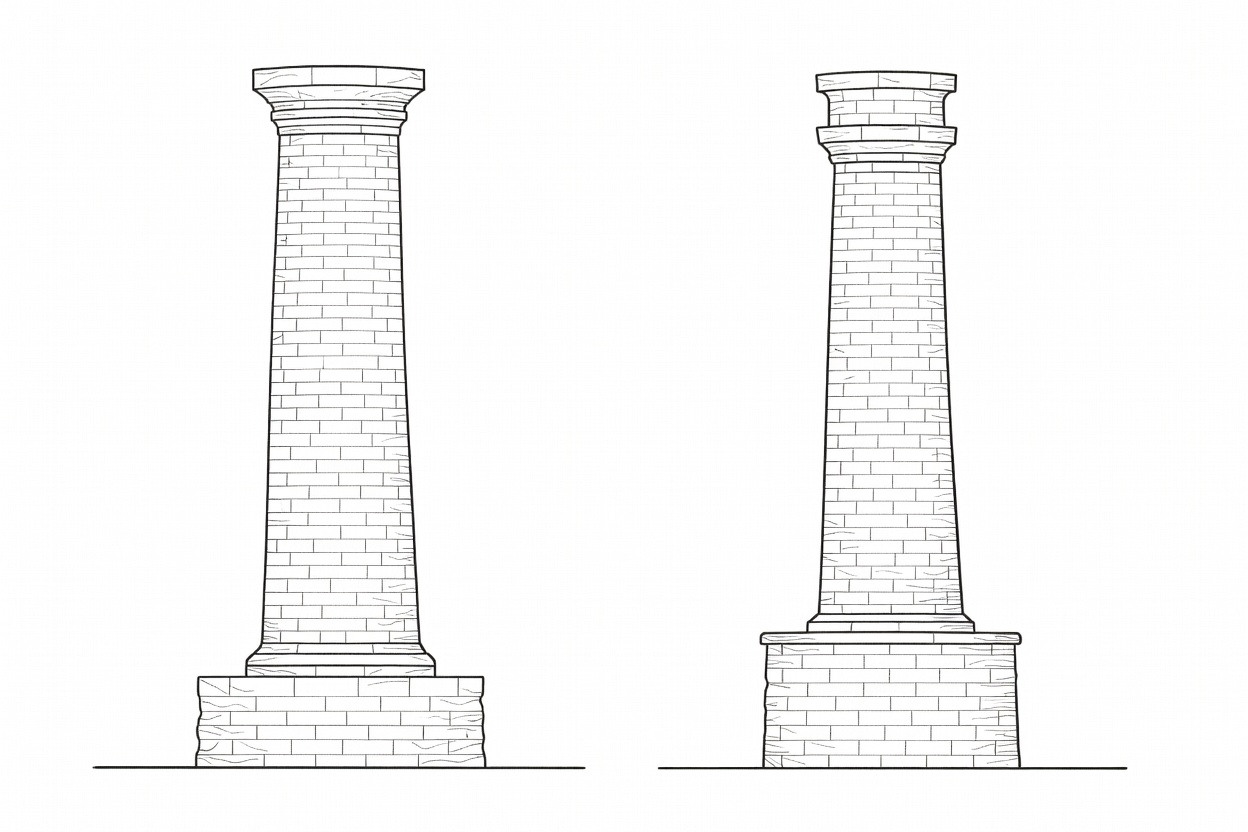
Eddystone: four attempts on one reef
Winstanley first. Timber frame, iron straps, an ornate lantern, decoration on every face. Handsome, and gone in the Great Storm with its builder inside. Rudyerd next. A smooth timber cone over a core of stone and brick, iron-bound, tapering cleanly to the lantern. Sound in the water. Fatal in fire. It burns from the lantern downward.
Smeaton changes the question. Stone, not wood. He takes the oak as his model: broad at the root, a curve that thins as it rises, the mass low where the sea hits hardest. Granite facing outside, Portland stone within, every block dovetailed to its neighbours. The tower holds. The rock beneath does not. The sea undercuts the ledge; the tower rocks in heavy weather. Trinity House dismantles the upper works and rebuilds them on Plymouth Hoe, where they still stand. The stump remains on the reef.
Douglass builds the present tower on the neighbouring rock. Taller, heavier, and with a new idea at the foot: a solid cylindrical drum with a vertical face. Breaking seas meet a wall and fall back instead of climbing the taper. The gallery sits well above the reach of ordinary spray. A helideck now caps the lantern.
Bell Rock: the shaft that stays wet
Inchcape reef, off Arbroath. Under water at every high tide. Robert Stevenson, with John Rennie as chief engineer to the Commissioners of Northern Lighthouses, adapts Smeaton's curve to a taller and slimmer shaft. Solid masonry through the lowest courses. Aberdeen granite for the outer skin where the sea strikes; sandstone above, where weight matters less than cost and workability. The entrance door sits high on the shaft, reached by a ladder. Above it the rooms stack one per floor: stores, kitchen, bedroom, library, lantern. The same masonry still stands and still works. Often described as the oldest surviving sea-washed lighthouse in the world.
Skerryvore: the hyperbolic profile
Alan Stevenson, Robert's son. A reef roughly twelve miles south-west of Tiree, open to the full Atlantic. His answer is the tallest tower in Scotland, about 48 metres to the lantern, with a profile drawn on a hyperbola. Flared hard at the base, tightening quickly, almost vertical near the top. The curve does two things at once. It puts mass where the overturning moment is greatest. It keeps the upper shaft slim so wind load stays modest. Ross of Mull granite, pink and dense, dressed at Hynish. Widely regarded as the most refined of the rock towers in these islands.
Fastnet: iron fails, granite follows
Fastnet Rock, south-west of Cape Clear, the most southerly point of Ireland. The first tower is cast iron: curved plates bolted into a tapering shell, designed by George Halpin for the Ballast Board. Storms shake it. Seas reach the lantern. The interior is filled with masonry to steady it. Not enough. The Commissioners of Irish Lights turn to William Douglass, of the Eddystone family, for a replacement. Cornish granite from Penryn. Every block dressed to template and every course trial-assembled ashore before shipping. Dovetailed on every face. The lowest courses are let into the rock itself. A wide-footed curve with the lantern lifted high enough to clear the worst seas.
South Stack: a tower that borrows height from a cliff
Different site, different problem. Ynys Lawd, a small island off Holy Island, Anglesey. Not wave-washed. The cliffs give elevation for free. Daniel Alexander, architect to Trinity House, designs a short, plain, whitewashed cylinder with keepers' dwellings attached. The tower is modest because the focal plane already sits high above the sea. The engineering effort goes elsewhere: a stair cut into the cliff and a bridge across the tidal gap. Iron rails, not granite curves.
What the profile does
| Site | Form | Material | Design driver |
|---|---|---|---|
| Eddystone (Douglass) | Curved taper on a cylindrical drum | Granite | Wave impact at the base |
| Bell Rock | Tall curved shaft, solid base | Granite over sandstone | Reef covered at every high tide |
| Skerryvore | Hyperbolic taper | Granite | Atlantic exposure, height for range |
| Fastnet | Wide-footed curved taper | Granite, dovetailed | Replace a failing iron shell |
| South Stack | Short cylinder with dwellings | Rendered masonry | Cliff site, access |
The reading list for any tower: base width against height, height of the solid courses, height of the door, height of the gallery, whether the face is smooth or stepped. All five stations say the same thing in different accents. Put the weight low. Keep the face clean. Lift the light.