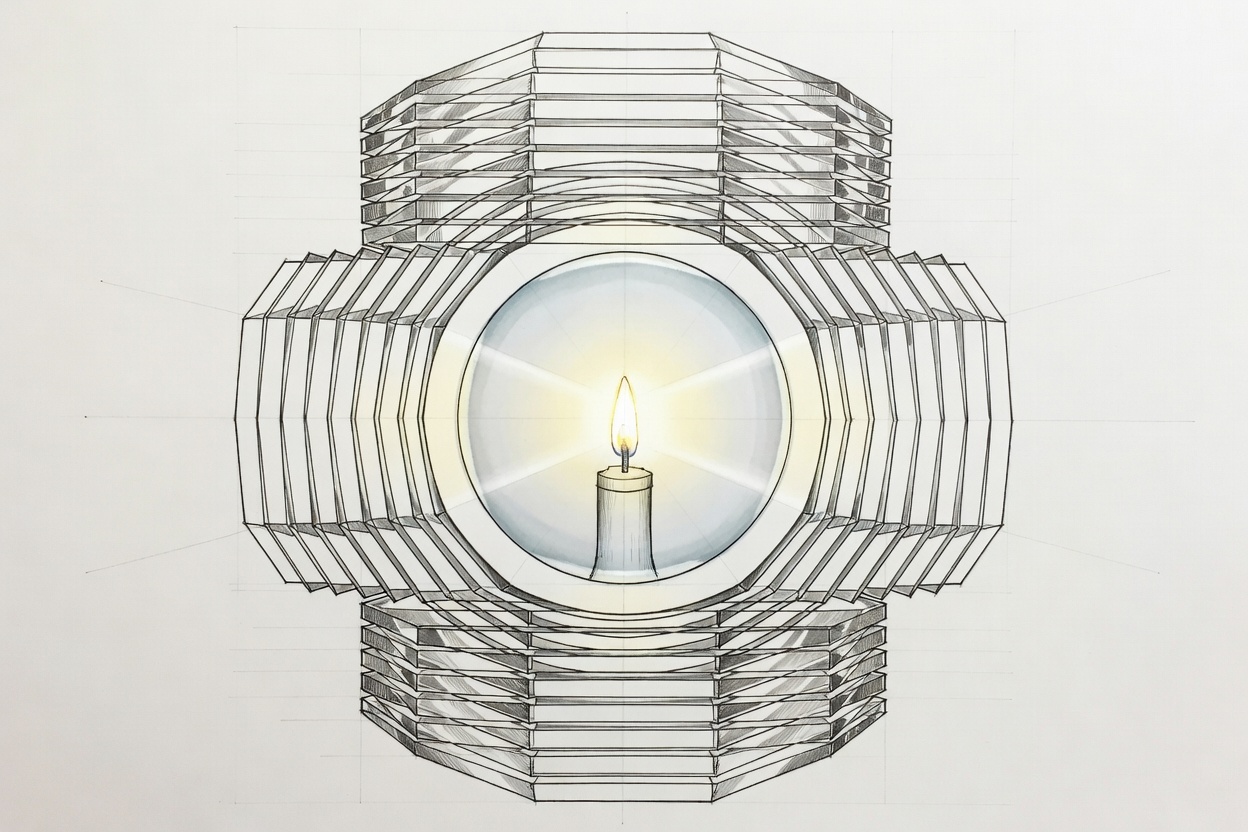
Before glass
Smeaton's Eddystone is lit by tallow candles on a chandelier, twenty-four of them. Coal braziers burn on other headlands. Then the Argand lamp: a hollow circular wick with air drawn up the middle, a glass chimney over it, a flame that is steady and bright and does not smoke the lantern black. Behind the flame a parabolic reflector, silvered copper, throws the light forward in a beam. This is the catoptric system, light by reflection. Mount several lamps and reflectors on a frame and turn the frame by clockwork and you have the revolving light, and with it the flash.
The Fresnel lens
Augustin Fresnel, working for the French lighthouse service, designs a lens as a central bull's-eye surrounded by concentric annular rings, each ring a prism. The stack gathers light that a single solid lens of the same aperture could not without impossible weight. Dioptric: light by refraction. Above and below the dioptric belt sit catadioptric prisms that bend and then totally reflect the rays that would otherwise escape to the sky and the sea. Together they send most of the flame's output to the horizon.
Apparatus is graded in orders by focal distance, the gap from flame to glass. First order: 920 millimetres. Second: 700. Third: 500. Fourth: 375. Fifth: 250. Sixth: 150. A hyperradiant apparatus, at 1,330 millimetres, is the largest class ever built and is installed at only a handful of stations in these islands, Bishop Rock among them. A fixed lens is a continuous drum and gives an even glow all round. A revolving lens is built of bull's-eye panels, each concentrating light into a beam; as the panels sweep the horizon the observer sees a flash. Chance Brothers of Smethwick become the principal British maker of lighthouse glass, supplying all three authorities.
Stevenson glass
Alan Stevenson fits Skerryvore with a first-order dioptric apparatus, among the earliest in Scotland. His brother Thomas develops the holophotal system: prism geometry arranged so that light leaving the flame in every direction is captured and redirected into the working beam, with almost nothing wasted. Northern Lighthouse Board stations become a proving ground for prism design. Trinity House and the Irish Lights follow the same lineage, buying from Chance and from French makers such as Barbier.
Burners
Sperm oil, then colza from rapeseed, then mineral oil and paraffin. Multiple concentric wicks for larger flames. Then the incandescent paraffin vapour burner: paraffin vaporised under pressure and burnt through a mantle, several times brighter for the same fuel. Acetylene from calcium carbide follows at unwatched lights, with Gustaf Dalén's sun valve shutting the gas off in daylight; the Nobel Prize in Physics recognises that work. Electric arc lamps are tried early at South Foreland and Dungeness, brilliant, expensive and temperamental. Electric filament lamps arrive with generators and mains. Then sealed-beam arrays. Now LEDs at most automated stations: low power, long life, colour by design rather than by filter.
Making it turn
Clockwork driven by a falling weight; the keeper winds it every few hours through the night. Roller bearings under the lens carriage, then the mercury float: the whole optic, tonnes of glass and brass, riding on a bath of mercury with almost no friction. Fast rotation becomes possible, so periods shorten and characters grow more distinctive. Electric motors replace the clockwork at electrification, and a small rotating beacon replaces the whole optic at many stations after automation.
Catoptric against dioptric
| Question | Catoptric (reflectors) | Dioptric (lens) |
|---|---|---|
| How light is gathered | Reflected from a silvered parabola behind each lamp | Refracted through prisms around a single lamp |
| Lamps needed | One per reflector, often many | One at the focus |
| Losses | Silvering tarnishes; light spills past the rim | Glass absorbs a little; prisms capture nearly all |
| Upkeep | Daily polishing of many surfaces | Cleaning glass; a single burner to trim |
| Character control | Number and grouping of reflectors on the frame | Number and grouping of panels; screens for occulting |
What survives
Many first-order optics remain in place and still turn, an LED source or lamp at the focus. Others are retired to museums and a compact beacon sits on the gallery or the lantern floor. Check the Admiralty List of Lights for what a station shows today. Check the authority's own station page for what the lantern room holds.