The tidal window
Rock sites are worked by the tide. Bell Rock uncovers for a couple of hours around low water, and only on the right tides. Skerryvore and Fastnet are never dry in any useful sense; work runs between breaking seas. Eddystone shows at low water springs. The season is summer only. A whole year may yield a few hundred working hours on the rock itself. Every decision follows from that arithmetic. Cut everything ashore. Land it fast. Fix it before the tide comes back.
Smeaton's kit of parts
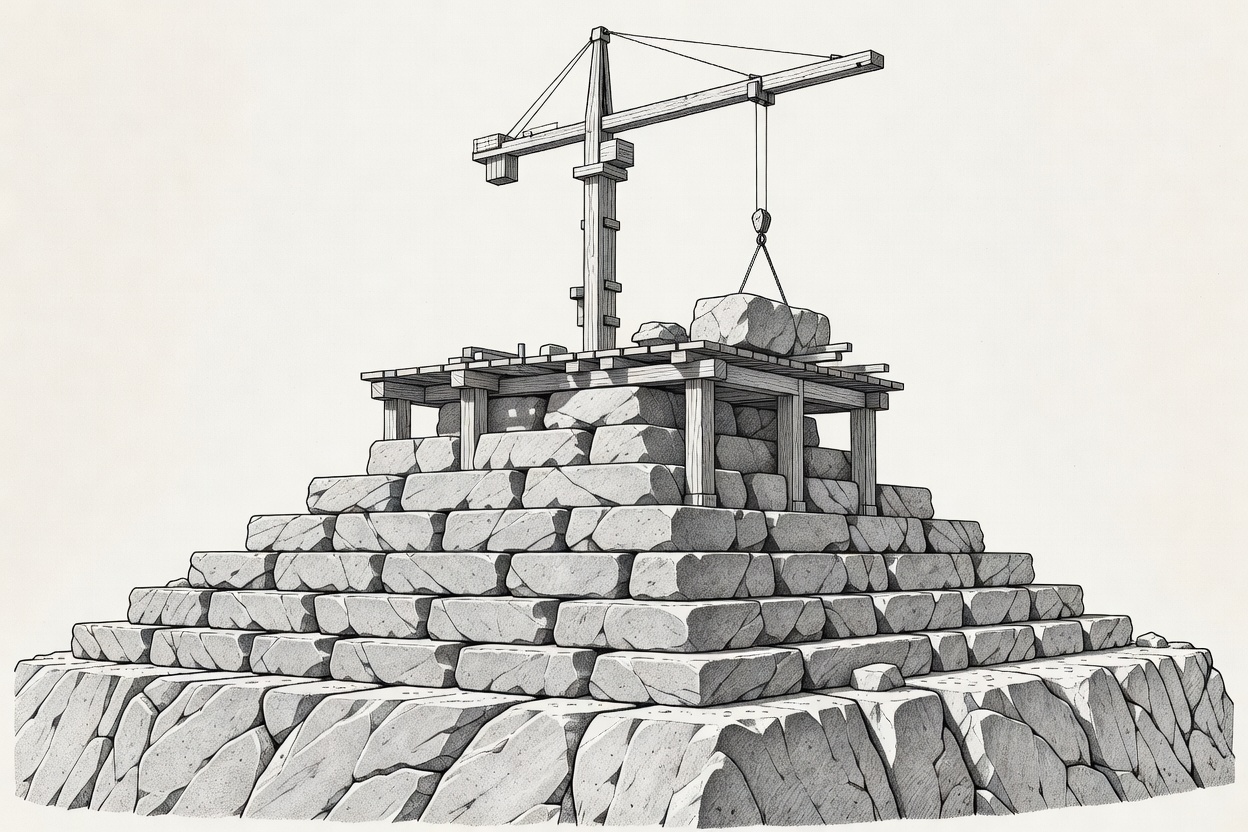
Smeaton brings three ideas to Eddystone. Dovetails: each block is cut so that it locks sideways into its neighbours, and each course is joggled into the one below, so nothing can slide out under wave suction. Trenails and dowels: oak pins and stone plugs driven through the joints hold the courses in place while the mortar cures. Hydraulic lime: he tests limes from different quarries and finds that lime burnt from limestone carrying clay will set under water; he adds Italian pozzolana to the mix. The result behaves as one stone. The rock is cut into level steps so that the first courses bed flat rather than on a slope.
Douglass, on the neighbouring rock a century later, has better tools and the same tide. He builds a low dam around the site to keep water off the lowest work and gain hours. The first courses are bolted into the rock, and the whole base is a solid drum of granite before a room appears.
Bell Rock: living on the work
The reef is too far from Arbroath for daily return. Stevenson builds a beacon house: a timber frame on iron-shod legs fixed to the rock, with a barrack well above the wave line. Crews sleep on site. A cast-iron railway on trestles carries stone from the landing points to the tower base, so nothing is dragged across the weed. The foundation pit is cut into the sandstone reef to receive the first course. Every stone is numbered and fitted on a platform in the yard ashore before it leaves. Granite courses first; sandstone above, once the sea no longer strikes the wall. The beacon and the tower stand side by side until the tower can house men itself.
Skerryvore: a barrack lost, then a pit blasted
Alan Stevenson follows the Bell Rock method and loses his first barrack to a winter storm before the second season opens. He rebuilds it. The rock is hard gneiss, uneven, and not kind to a chisel; the foundation pit is blasted and hand-dressed to a level floor. Granite comes from the Ross of Mull. A shore station and pier at Hynish on Tiree handle dressing, storage and shipment, with a signal tower to talk to the rock. Blocks are large, the lowest courses solid, the shaft rising from a circular base sunk into the rock.
Fastnet: keying granite into slate
The Fastnet is clay slate, not granite. It cleaves. Douglass lays the lowest courses so that each block sits in a recess cut into the rock, the hard granite gripping the softer stone rather than resting on it. Above, every course is dovetailed top, bottom and sides. Blocks are landed from a tender in narrow weather windows and moved by steam crane. The seaward courses are carried deeper than the landward ones, so the base is not a plain circle but a shape that meets the direction of the sea. It is the last of the great granite rock towers built for these islands.
South Stack: foundations in the air
No tidal window. Bedrock on the island top is sound and the tower and dwellings stand on conventional footings. The problem is getting there. Trinity House cuts a stair down the mainland cliff, several hundred steps. The chasm between mainland and island is first crossed by rope and basket, then by an iron suspension bridge, later replaced. The foundations that matter here are under the stair and the bridge abutments, not under the tower.
Comparison
| Site | Rock | First-course method | Working base |
|---|---|---|---|
| Eddystone | Gneiss | Stepped bed, dovetails, trenails; later bolts and a dam | Yard at Plymouth |
| Bell Rock | Sandstone reef | Cut pit, dovetailed granite | Beacon house, rock railway, yard at Arbroath |
| Skerryvore | Gneiss | Blasted pit, solid courses | Barrack on rock, station at Hynish |
| Fastnet | Clay slate | Blocks recessed into rock, full dovetailing | Landing and steam crane, yard at Penryn |
| South Stack | Cliff bedrock | Conventional footings | Stair and bridge |
What to look for in any account of a rock foundation: hours actually worked per season, weight of the largest block, height of the solid base, and how the first course meets the rock. The answers separate a tower that lasts from one that is rebuilt.