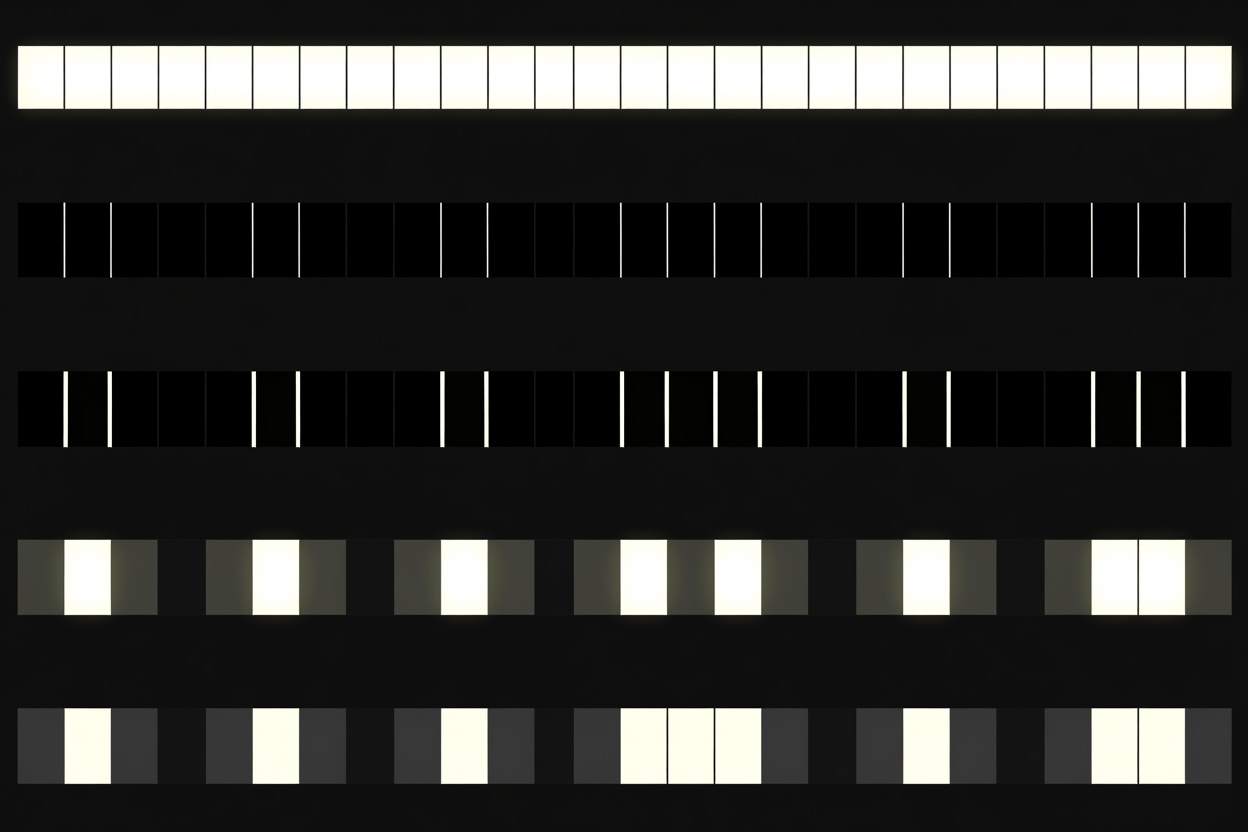
What a character is
The pattern of light and dark that a station repeats, made distinct from every neighbour within range. The standard vocabulary, as used by the International Association of Marine Aids to Navigation and Lighthouse Authorities and in the Admiralty List of Lights:
- Fixed (F) — a steady, continuous light.
- Flashing (Fl) — the dark is longer than the light. Group flashing Fl(3) — flashes in groups, here threes. Long flash (LFl) — each flash two seconds or more.
- Occulting (Oc) — the light is longer than the dark; the beam is interrupted rather than shown. Group occulting Oc(2) likewise.
- Isophase (Iso) — light and dark of equal length.
- Quick (Q) — fifty or sixty flashes per minute. Very quick (VQ) — one hundred or one hundred and twenty.
- Morse (Mo) — a Morse letter, written Mo(A) and so on.
- Alternating (Al) — colour changes within the period.
How the chart writes it
A worked example, not any real station: Fl(2) W 15s 41m 22M. Read it left to right. Two white flashes in every fifteen-second period. Focal plane 41 metres above the datum. Nominal range 22 nautical miles. The period is measured from the start of one group to the start of the next. On United Kingdom Admiralty charts the elevation is above Mean High Water Springs. Each light also carries a number in the Admiralty List of Lights and Fog Signals, the reference that ties the chart symbol to full detail.
Making rhythm from glass
A revolving optic sets the character by panel count and rotation. Four bull's-eye panels on a sixty-second turn give a flash every fifteen seconds. Two panels close together, then a blank arc, give a group of two. Faster rotation on a mercury float gives shorter periods. Occulting characters come from screens revolving around a fixed lens, or from a lamp switched on and off. Once electricity arrives, any rhythm is cheap; the character can outlive the optic that first produced it, reproduced by a small beacon and a timer.
Colour and sectors
White carries furthest and is the main colour of a landfall light. Red and green sectors cover dangers or mark the safe approach, made with coloured glass in the lantern panes over a set arc, or with coloured screens inside the lantern. Coloured light has a shorter nominal range because the glass absorbs part of the beam, so the chart may show two range figures. Sector limits are given as bearings from seaward, and a change of colour as you cross a bearing is itself a fix.
Range: two different questions
Geographical range asks how far the curve of the earth lets a light be seen at all. It depends on the height of the light and the height of the observer's eye. Nominal range asks how far the light's intensity carries through a standard atmosphere, defined as the luminous range in meteorological visibility of ten nautical miles. The chart gives nominal range. In rain the real range falls below it. In clear air the loom of a strong light shows above the horizon before the light itself. A cliff-top light such as South Stack gets its geographical range from the cliff; a rock light such as Skerryvore has to build its own with height.
Sound as a character
Fog signals carry characters too, written as blasts per period. Early stations fire explosive charges from a jib on the gallery. Others ring bells by clockwork. Then sirens and diaphones, the diaphone with its low grunt at the end of each note, driven by compressed air from engines in the base. Electric emitters follow, and many signals are withdrawn as radar and satellite positioning spread. Bell Rock is named for a bell before any light stands there, in the legend of the Abbot of Arbroath's warning bell on the Inchcape reef; its own fog bells were once rung by machinery. Automated stations use fog detectors to switch the signal on.
Daymarks
By day the character is the paint. White render on South Stack against dark rock. Bands on towers where confusion with a neighbour or with the landscape is likely. Bare grey granite on many rock towers, where the shape alone is the mark. Colour and pattern are recorded in the List of Lights alongside the character, because a navigator in daylight needs the same certainty.
| Field | Meaning | Where set |
|---|---|---|
| Character | Rhythm of light and dark | Optic panels or switching |
| Colour | White, red, green, or alternating | Source, filters or sector glass |
| Period | Seconds for one full cycle | Rotation speed or timer |
| Elevation | Focal plane above high water | Tower height plus site |
| Range | Nominal, in nautical miles | Source intensity and optic |